
Drip vs. Micro-Sprinkler Irrigation for Almonds: A Practical Comparison
Drip and micro-sprinkler systems both water almonds well, but they differ in wetted volume, pressure needs, maintenance and fit — here is how to choose for your orchard.
Ask a room of almond growers which irrigation system they prefer and you will get several firm answers, most of them shaped by the well they happen to own. That is the honest starting point. Drip and micro-sprinkler both put water in the root zone, both can be automated, and both will grow a decent crop when they are managed with some attention. The differences show up in the details: how the water spreads underground, what the hardware demands in pressure and repairs, and how the whole thing behaves on your soil and your slope. What follows is a practical comparison, not a verdict.
Two Ways to Wet the Ground
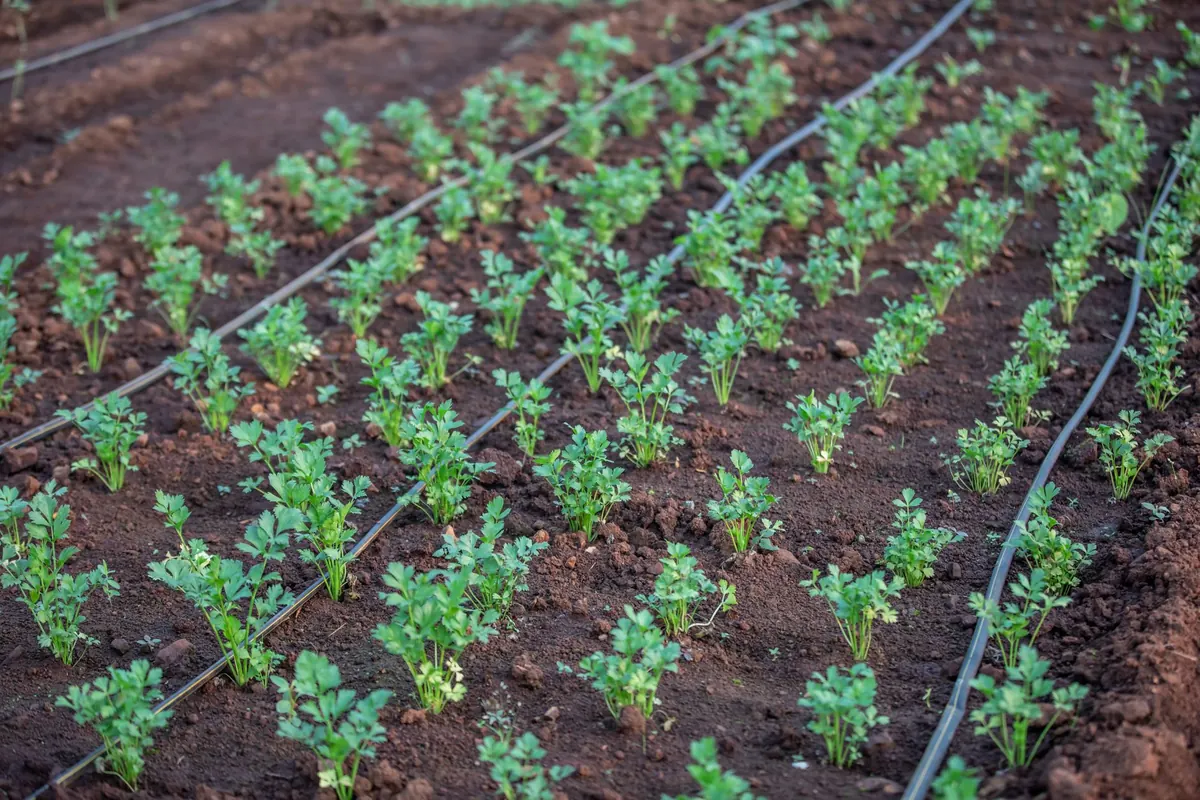
A drip system runs polyethylene tubing down the tree row, with emitters or built-in drippers releasing water slowly at each tree. The wetted zone is a bulb or a narrow strip. Roots concentrate there, which is efficient but also means the tree is farming a small volume of soil. Everything you do — fertilizer, salinity management, leaching — happens inside that volume.
Micro-sprinklers take a different approach. One or two heads per tree sit on risers and throw a circle of water that wets a much broader, shallower area, closer to what a good rain would do. The soil reservoir is larger, roots spread wider, and a young tree in particular finds it easier to establish. The trade is that you are now wetting ground beyond the tree row, and you are doing it in the air, where wind and sun get a vote.
Water Use and Efficiency
Drip has the edge on paper. Water goes straight to the root zone with very little evaporation, no wind drift, and no wetting of the middles where there are no roots. Pressure-compensating emitters hold their output across long runs and uneven ground, so distribution stays reasonably uniform even in a block that is not perfectly level.
Micro-sprinklers lose some water to evaporation and wind, and they germinate weeds between the rows. But efficiency on paper is not the whole story. Because drip wets a smaller volume, the soil holds less of a buffer, so a missed set or a clogged line shows up in the tree faster. On sandy ground, that narrow wetted bulb can mean more frequent, smaller applications. Micro-sprinklers build a bigger reservoir and can push salts down and away from the root zone more easily, which matters on heavier or slightly saline ground.
The real equalizer is management. A well-run micro-sprinkler block will out-perform a neglected drip block every season, and the reverse is just as true. What you are really choosing between is a system that rewards precision and one that rewards coverage.
Installation: Pipe, Pressure and Pump
Drip uses more linear feet of tubing and a good filtration setup — fine screens or media filters, pressure regulators, and a flush manifold at the end of every block. Because flow rates are low, mainlines and pumps can be smaller. This is often the deciding factor on a property with a modest well. Drip lets you irrigate in blocks, one at a time, without starving the system of pressure.
Micro-sprinklers use less pipe but need larger mains, higher flow and more pressure at the head. That means a bigger pump, more energy per hour of running, and less tolerance for a weak supply. Risers also have to survive real life in an orchard: mowers, harvest equipment, and the occasional truck that takes a corner too tight. Set every head plumb and at the same height, because a sprinkler leaning a few degrees throws its pattern onto the next tree.
Before you commit, do a pump test and write down the numbers — flow and pressure at the outlet, not what the seller told you five years ago. Then ask a designer to check whether that supply can carry the block at peak demand in July. It is a cheap hour of advice that saves expensive rework.
Maintenance: The Part Nobody Budgets For
Both systems need a routine, but they fail differently, and knowing how saves you surprise costs.
- Clogging. Drip emitters have small openings and are sensitive to fine sediment, iron, and organic growth. Plan on flushing lines, cleaning filters, and treating periodically for mineral or biological buildup. Micro-sprinkler heads have larger openings and shrug off particulates, but insects, spiders and birds find them interesting, and a partially blocked head quietly under-waters one tree.
- Physical damage. Rodents and coyotes chew drip tubing; mowers and harvest crews break risers. Keep a repair kit in the truck and a map of the block so you can find the leak fast.
- Misalignment. Sprinklers get knocked off vertical, and a head spraying sideways is watering a fence post. Walk the block after every field operation.
- Wet trunks. A sprinkler that soaks the crown area keeps the trunk base damp, which is exactly the condition that favors crown and root rots. Aim the pattern away from the trunk and check it after any adjustment.
- Weeds. The wider wetted area under sprinklers germinates more weeds between trees. Budget for that in your floor management.
Whichever system you run, the best diagnostic is a shovel. Dig a hole a few hours after a set and look at how far the moisture has spread and how deep it went. If the wetting front stops a hand's width below the surface, you are irrigating too shallowly, whatever the hardware in the ground.
Matching the System to Your Orchard
Soil
Sand holds little water, so a small wetted bulb dries quickly. Micro-sprinklers, with their broader wetted volume, often suit sandy blocks and young plantings better. Heavier soils hold more, and drip gives you finer control over how much goes in — useful when over-watering risks waterlogging and root problems.
Slope and layout
On rolling ground or long runs, pressure-compensating drip is hard to beat for uniformity. Sprinklers on a slope can put water on faster than the soil accepts it, and runoff down a furrow is water you paid for and did not use.
Water supply and quality
A low-yield well points to drip, simply because it lets you irrigate smaller blocks at a time. Water high in salts may favor sprinklers, since the wider wetted zone makes leaching more practical. Get your water tested either way; hardness and iron change your maintenance routine more than any brochure suggests.
Trees, harvest and climate
Many growers start young trees on micro-sprinklers for faster establishment, then move to drip as the orchard matures. Think about harvest too: almonds are shaken onto a dry, swept floor, and a system that keeps the middles damp can delay that work and raise humidity in the canopy. In blocks with a history of hull rot, that extra humidity around splitting hulls is worth weighing. Micro-sprinklers can also double as a frost tool during bloom in some situations — a design decision to make with local advice rather than a reason on its own.
Making the Decision
If you are choosing for a new block or replacing an old system, work through these in order:
- Test the pump and record flow and pressure at the outlet. Everything else depends on this.
- Dig three or four holes across the block and feel the soil. Texture and depth decide how water spreads.
- Map slope, block size and where you can reasonably run mains.
- Test the water for hardness, iron and salinity.
- Find two growers on similar ground running each system, and ask what breaks and how often.
- Budget the maintenance, not just the install. Filters, repairs and time in the field are part of the price.
Neither system forgives neglect, and both will reward a grower who walks the block with a shovel and a notebook once a week. Pick the one whose weaknesses you are willing to live with, because those are the ones you will be dealing with every season.
Photo: Anil Sharma / Pexels